
The anti-refugee laws & the assault on asylum rights
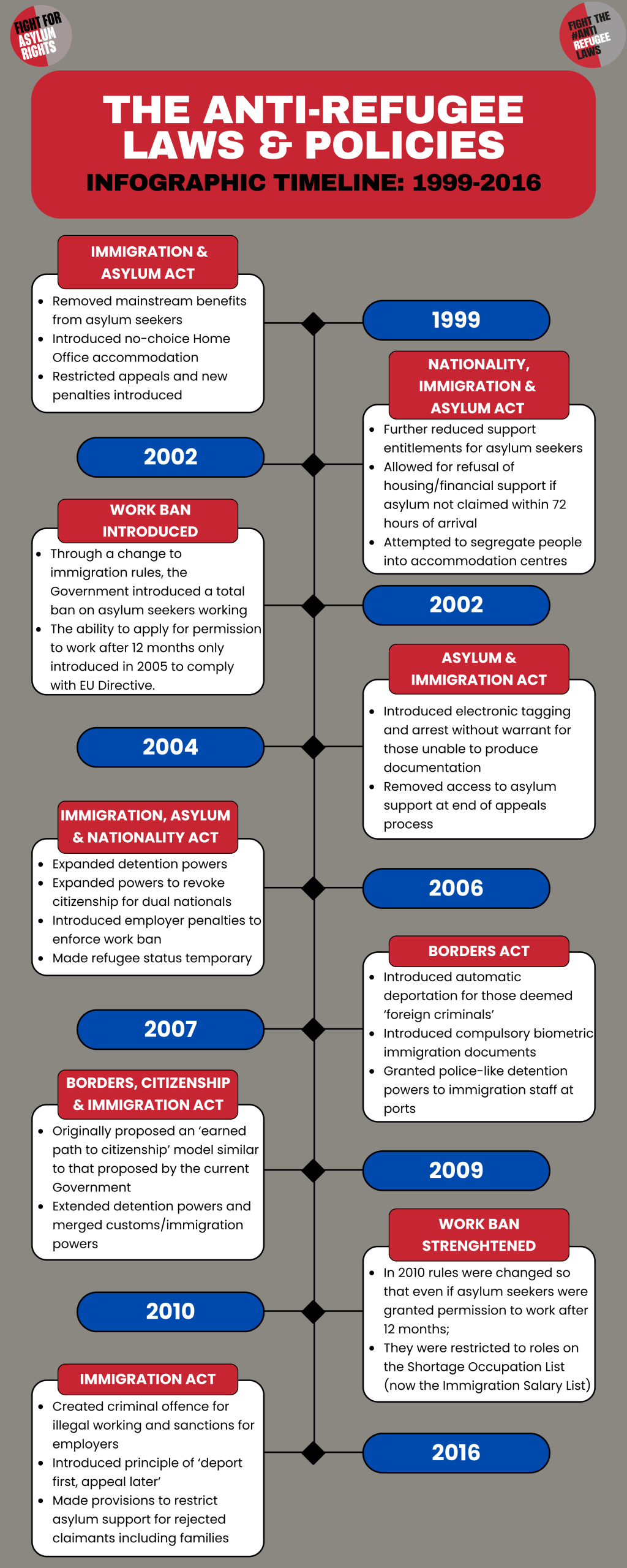
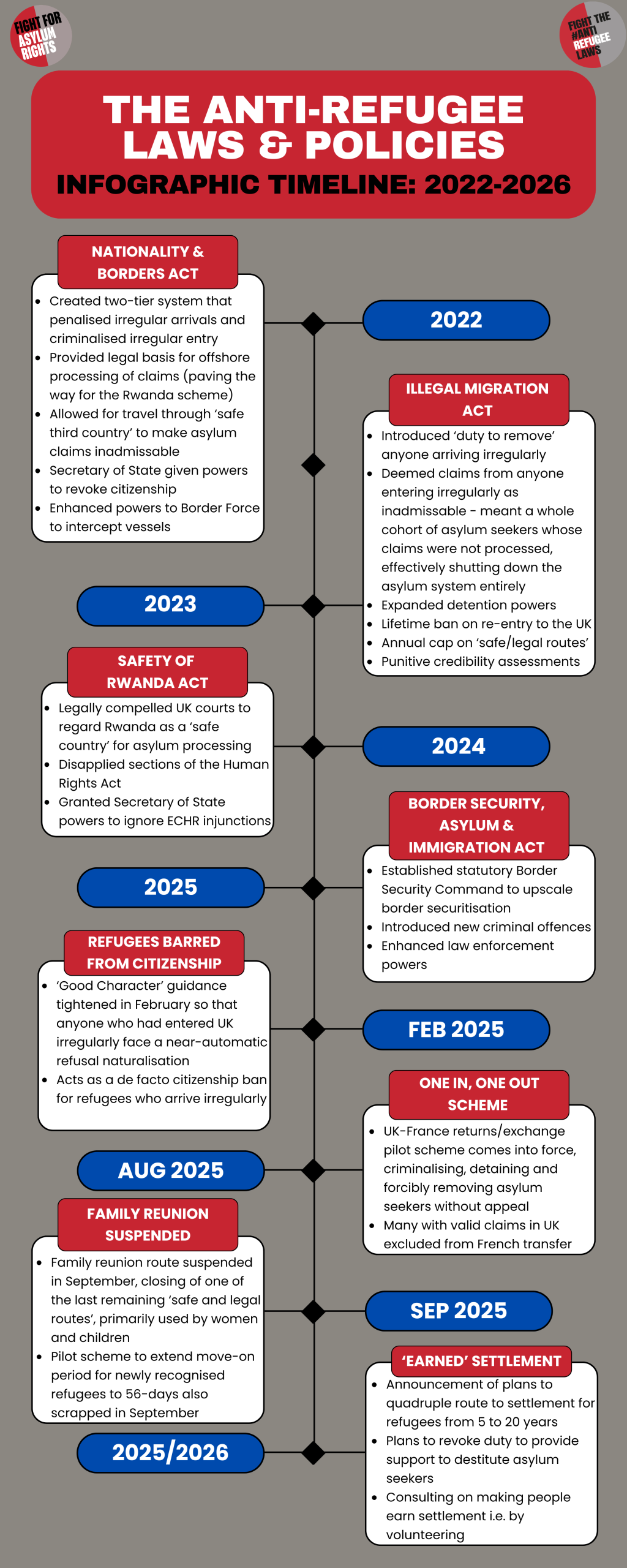
The anti-refugee laws and policies are destroying asylum rights in the UK. From permitting the unjust criminalisation of refugees, to the offshore processing of people seeking asylum and the creation of warehouse-style refugee camps on UK soil, successive pieces of hostile legislation and policies are ripping up internationally recognised rights for people fleeing war and persecution, and threatening the UK’s reputation as a safe haven for victims of torture and persecution.
These laws and policies have been costly to implement and ineffective – creating ever-longer backlogs and delays in the asylum process that have left people facing homelessness and destitution. They’ve put vulnerable people in limbo if not inflicting detention, imprisonment and retraumatisation.
From the Nationality & Borders Act of 2022 that created a two-tier system and criminalised refugees for the simple act of seeking safety, to the Illegal Migration Act of 2023 that doubled down on these new powers and even closed the asylum system for an entire cohort of arrivals, to the Safety of Rwanda Act of 2024 that sought to overturn a Supreme Court ruling in order to offshore and deport refugees to an unsafe third country, now to the upcoming Border Security, Asylum & Immigration Bill of 2025 which will entrench the criminalisation of people seeking asylum and ratchet up the securitisation of our borders that is killing people in the Channel – successive government’s have launched a sustained legislative assault on asylum rights.
Successive UK Governments have promised to ‘stop the boats’ and ‘smash the gangs’. Rather than breaking the business model of people smugglers, the anti-refugee laws and policies pursued by these governments are leaving people vulnerable to exploitation and reliant upon criminal gangs in order to reach safety.
Missing from the legislation is any attempt by the Government to introduce new safe routes for people fleeing war and persecution to claim asylum in the UK, such as a long-term and ambitious commitment to refugee resettlement or expanded family reunion schemes. It’s the lack of such safe routes that drives people to risk their lives to cross the dangerous Channel in flimsy boats.
Refugee rights are human rights and by taking away these fundamental protections, the anti-refugee laws violate the principle that human rights belong to us all. It’s time to stand up for human rights and fight the anti-refugee laws.
We have to fight back. Join the fight for asylum rights today.
The assault on asylum rights by the current Government
Since the July 2024 election, the UK government has introduced a series of policy changes and operational practices that, taken together, represent a rapid erosion of asylum and refugee rights. These measures lengthen precarity, target routes to safety (resettlement and family reunion), increase the time and conditions needed to secure permanent status, expand enforcement and removals, and tighten accommodation and support for people in the asylum system.
The effect is predictable: more uncertainty and destitution for people who have fled persecution; greater barriers to rebuilding a life; and incentives that force people into longer, more precarious limbo. These changes also disproportionately harm people with intersecting vulnerabilities, including disabled refugees and people from racialised communities.
The Border Security Command and the escalation of border violence (July 2024-)
In July 2024 the Home Office established the Border Security Command, which was given a statutory footing with the passage of the Border Security, Asylum & Immigration Act in December 2025, continuing the trend towards ever more border securitisation, militarisation and criminalisation, particularly since the UK-France Sandhurst Treaty of 2018. Extensive research has linked this to an escalation of state-sponsored border violence and record fatalities in the English Channel. Despite soaring and avoidable fatalities, the government does not officially record or report on these deaths, and refused to engage with amendments in Parliament in 2025 that would have addressed this data gap. (More info from Humans for Rights Network, Project Play and Refugee Council)
Suspension of Syrian asylum claims (Dec 2024)
From December 2024 to July 2025, the UK Government paused the processing of Syrian asylum and settlement applications. Over 730 organisations and individuals on the frontline of providing support to people seeking asylum wrote to the Home Secretary urging the government to restore processing of asylum applications, to grant Syrians and other asylum seekers waiting over six months for a decision the right to work, and to commit to no forced returns of Syrians in the UK.This suspension of processing, at a time when the Foreign Office continued to advise against all travel to Syria, left at least 6500 Syrians in legal limbo and fear of coercive returns. Despite the UK Government itself still highlighting “deeply concerning” violence, mass displacement of civilians and a deteriorating humanitarian situation in Syria, the Home Secretary announced in November that it is considering enforced returns. (More info from GMIAU, UNHCR and Right to Remain)
Ramping up of raids and forced returns (July 2024-)
From July 2024 to December 2025, more than 17,400 immigration raids took place, a record high. Despite research showing that it is government policy in the form of the ban on legal work that drives people seeking asylum into exploitative and dangerous irregular working, the Home Office has broadcast their violent immigration raids with what NGOs have described as “ICE-style” videos on a dedicated TikTok account – demonising migrants and undermining social cohesion. Alongside an increase in raids and detentions, the government has sought to ‘fast-track’ deportations by widening the ‘deport now, appeal later’ scheme, expediting the Early Returns Scheme and establishing a tighter statutory appeals timeframe, despite the deepening immigration and asylum legal aid crisis. (More info from UNHCR & British Red Cross, Migrants’ Rights Network and The Migration Observatory)
'Good Character' guidance amended to block refugees from citizenship (Feb 2025)
In February 2025, the government updated the ‘Good Character’ guidance for naturalisation applications with immediate effect to in practice deny citizenship to anyone who arrives in the UK irregularly. Considering that 95% of people who arrive in the UK irregularly via small boat claim asylum, this serves as an effective ‘refugee ban’ on British Citizenship for new arrivals. This contravenes with Article 31 of the Refugee Convention which protects refugees and asylum seekers from being punished for entering or being in a country without official permission. (More info from GMIAU, Richmond Chambers, and Asylum Matters)
"Failure to Travel" guidance published (July 2025)
In July 2025, the government published new “Failure to Travel” guidance to remove accommodation and financial support from any single adults seeking asylum who refuse to travel to new “no-choice basis” asylum accommodation without a ‘valid reason’, with a narrower definition of ‘valid’ – threatening to plunge more people seeking safety into homelessness and destitution. (More info from Right to Remain)
“One-in one-out” scheme introduced (Aug 2025)
The ‘one in, one out’ pilot scheme with France came into effect in August 2025, which means anyone seeking asylum in the UK, regardless of the legitimacy of their need for humanitarian protection or their links to the UK, can be in scope for the returns agreement by having their claim deemed ‘inadmissible’, simply by virtue of travelling through France to reach the UK. According to 21 British and French refugee and migrant organisations, the scheme has been marked by harsh detention conditions, excessive uses of force, safeguarding failures, inadequate access to legal advice and severe mental harm. (More info from Refugee Action, Medical Justice and Right to Remain)
Suspension of Refugee Family Reunion (Sep 2025)
In September 2025, the Home Office announced a “temporary” suspension of refugee family reunion applications, effectively shutting down one of only remaining so-called “safe and legal” routes available to people seeking asylum in the UK, with a disproportionate impact on women and children who made up 92% of family reunion grants according to Home Office data. This is being challenged in the High Court by Safe Passage, and over 60 organisations have condemned the suspension of this route and the new Appendix FM system that now forces refugees to meet a minimum income requirement that 50% of the UK working population would not meet to reunite with their loved ones in a place of safety. This followed the government closing Afghan refugee resettlement routes in July 2025. (More info from Helen Bamber Foundation and Safe Passage)
U-turning on 56-day move-on period and driving up refugee homelessness (Sep 2025)
In response to a sharp increase in homelessness being driven from the asylum system, the move-on period, after which time people who have been granted refugee status have to leave Home Office accommodation, was extended from 28 to 56 days in December 2024 for a six-month trial, which was extended to the end of the year in July 2025. The government u-turned on this decision in September 2025 and prematurely ended the pilot for most single adults, meaning they reverted to 28 days, which drives up refugee homelessness, despite the warnings of 64 expert organisations. A legal challenge forced the government to maintain the 56 day period for families and those classed as ‘vulnerable’ until 8th March 2026. From 9th March, the new move-on period will be 42 days, which experts say will continue to be a substantial driver of rough sleeping and homelessness. (More info from NACCOM, Boaz Trust and JRS)
Opening new harmful asylum camps (Oct 2025)
In October 2025, the government announced its plans to move hundreds of people seeking asylum into military sites, announcing two new camps at Cameron Barracks in Inverness and Crowborough in East Sussex, despite pledging to shut down existing camps prior to the General Election. In January 2026, the Home Office began moving people into Crowborough, where conditions have already been described as akin to ‘a concentration camp’ by observers. The National Audit Office, the Public Accounts Committee and the Home Affairs Select Committee have all found that large-scale sites like these have failed to deliver value for taxpayer money and have resulted in ‘billions squandered’, costing even more than hotels. There is also a wealth of research evidencing the harm inflicted on people accommodated in these camp settings. (More info from Asylum Matters, HBF & HFRN, MSF & DOTW, Runnymede Trust & Care4Calais and the APPG for Immigration Detention)
“Earned Settlement” and 20-year+ limbo for refugees
(Nov 2025)
In November 2025 the Home Secretary introduced the Restoring Order and Control policy statement and announced plans to end automatic settlement in favour of an “Earned Settlement Model”. The Home Office launched a consultation on these proposals which will undermine integration and severely harm refugees who are being threatened with a (potentially unfairly retrospective) 20-year limbo of insecurity waiting for settlement, or even as long as 30 years by penalising refugees for ‘illegal entry’ in contravention with Article 31 of the Refugee Convention. These changes will disproportionately impact lower-income households and discriminate against people of colour, women, those with caring responsibilities, people with illness or disability, children and victim-survivors of domestic abuse, modern slavery and human trafficking. They increase poverty, homelessness and NRPF hardship, with local authorities facing greater demand. Initial proposals to effectively mandate volunteering were condemned by over 300 charities including NCVO. (More info from Praxis/GMIAU, RMC, The Migration Observatory, MRN, NRPF Network and the APPG for Migration)
Temporary [30-month] Refugee Status (Mar 2026)
In March 2026, the Home Secretary created a new temporary status called for newly-granted refugees, meaning they will have their protection needs ‘reviewed’ every 30 months. For those whose country is now deemed to be safe by the Home Office, they will be expected to return there – either voluntarily or by forcible deportation. This scheme has been condemned by UNHCR. Refugee Council estimates these changes will cost taxpayers up to £1.27bn, and Australia scrapped temporary protection visas in 2023, citing it making ‘no sense – economically or socially’ to keep people in limbo. Other critiques of the policy suggest it is inconsistent with human rights and international law and that it will disproportionately harm women and survivors of sexual and gender-based violence. (More info from UNHCR, GMIAU and Refugee Council)
Shutting down more safe routes (Mar 2026)
In March 2026, the Home Office imposed an emergency ban on student visas from Afghanistan, Cameroon, Myanmar and Sudan, and work visas for Afghans – shutting down further “safe and legal” routes for asylum for those from high refugee-grant rate countries. NGOs warn these changes will drive refugees into irregular and dangerous routes. (More info from House of Commons Library and HEPI)
Revoking the legal duty to support destitute asylum seekers (Mar 2026)
In March 2026, the government announced that it will revoke the legal duty to provide accommodation and financial support to destitute asylum seekers, changing it from a statutory obligation to a discretionary power, and it laid down statutory instruments on 5 March 2026 to bring this into force from June 2026. Financial and accommodation support is the only lifeline for destitute asylum seekers banned from work, and it already leaves people in dire poverty. Revoking the legal duty to provide this support risks driving asylum seekers into homelessness and further destitution, and placing additional pressure on local authorities. (More info from NACCOM and Asylum Matters)
Immigration & Asylum Bill (June 2026)
The new bill is how the Government will turn many of the assaults on asylum rights announced in the Restoring Order and Control statement into law. It introduces a £10,000 ‘refugee tax’ which people would have to pay once granted asylum status; narrows the definition of family life in human rights claims; changes how modern slavery cases are assessed and creates a new Independent Appeals Authority which replaces trained immigration judges with less experienced adjudicators. It establishes the new ‘core protection status’ which allows the Government to make refugee status temporary. (More info from Right to Remain here.)
Family returns and stripping support from families (Mar 2026)
In March 2026, the government launched a ‘family returns’ consultation to operationalise provisions of the Immigration Act 2016 that would strip support from refused families, individuals, and care leavers. This would shift the onus of support to destitute families to local councils, who, with the proposed new framework, will have less grounds to support vulnerable families and will lead to children and care leavers living in destitution on our streets. They are also seeking to permit immigration officers and detainee custody officers to use physical force, including forcible carrying and the use of handcuffs, to intervene when an accompanied child ‘does not comply with a requirement to leave the UK’. Examples given when such force may be used include ‘a child wilfully and aggressively refusing to board a plane’ and ‘a parent refusing to release a child’s hand’. (More info from ASAP and ILPA)
Background
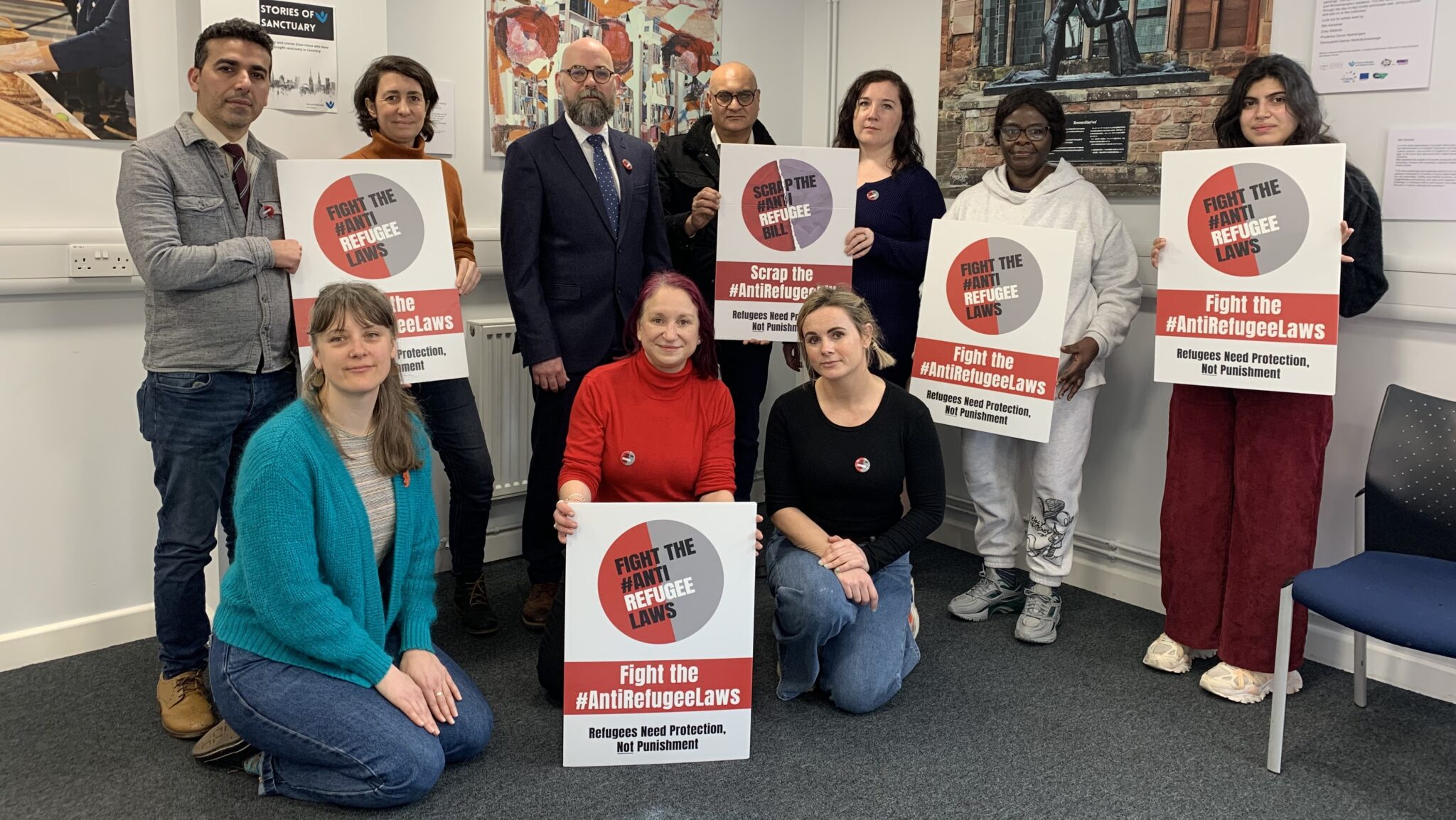
The ‘Fight for Asylum Rights’ campaign was born out of Asylum Matters’ and Refugee Action’s joint ‘Fight the Anti-Refugee Bill/Fight the Anti-Refugee Laws‘ campaign and was kicked off by the Fight the Anti-Refugee Laws pledge (now the Fight for Asylum Rights pledge) which was launched in April 2022 to act as a focal point and catalyst for organisations following the gruelling passage of the Nationality and Borders Act. Hundreds of individuals and organisations signed the pledge, with the movement against successive pieces of hostile anti-refugee legislation growing.